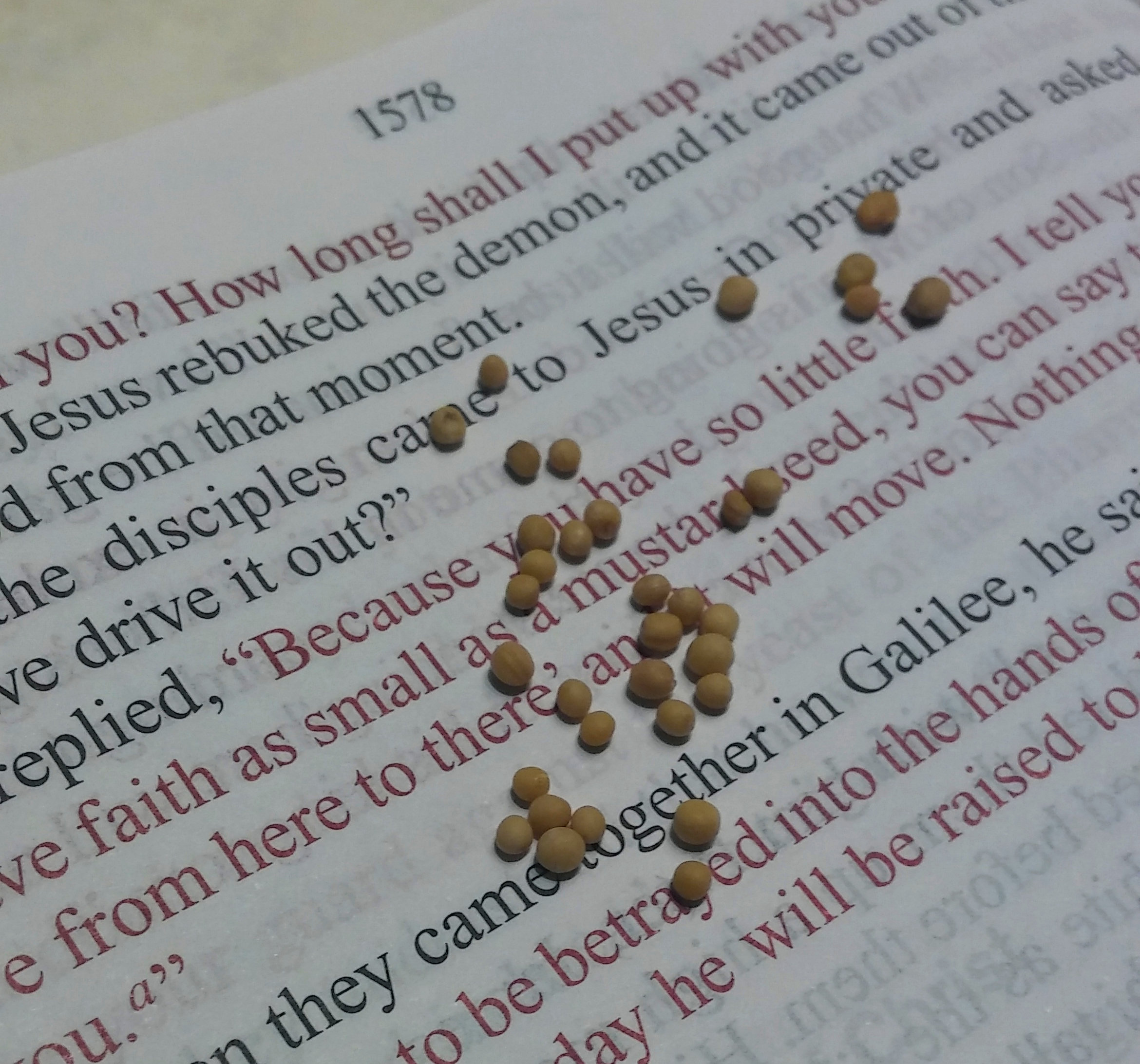
Recently, our Pastor gave a sermon on Matthew 17:14-20. In this story, Jesus is up the mountain with Peter, James and John, and when they come down a man approaches Jesus to ask him to help his son, who is demon possessed. The man had asked the disciples to help, but they could not do it, so Jesus rebuked the unclean spirit, telling it to leave the boy, and it did. The disciples didn’t understand why they were unable to cast it out, so Jesus tells them about a mustard seed.
Our pastor was using these passages in scripture as an example of how faith works. That it only takes the smallest, really almost microscopic, amount of faith to move whatever your mountain, because nothing is too large for God to accomplish. But as he was telling the story, I couldn’t help but think that maybe there was more to the story, maybe it wasn’t just about how faith works, but also about how misplaced faith never works.
In the story, Jesus says, “You unbelieving and perverse generation,” and I love the Contemporary English Version which states, “You people are too stubborn to have any faith.” When he says this, Jesus is not only talking to the people who are continually hounding him for a miracle, but because they ask about why they couldn’t do it, he’s also talking to his disciples. He tells them they have a faith problem, that they “don’t have enough faith,” and that if they had “faith no larger than a mustard seed, they could tell a mountain to move and it would.” A mustard seed is really, really small, and Jesus tells them that they didn’t have even the tiniest bit of faith.
Wait, what? They didn’t have faith the size of a mustard seed? That would be like having no faith at all, and they’d been healing the sick and such all day, so they had to have something, right? It occurred to me right then, what Jesus was alluding to. It wasn’t necessarily that they had no faith, but moreover that their faith was resting in the wrong hands. It was misplaced. They had started to convince themselves that they were the reason the miracles were happening, they got full of themselves, and when they came up against a hard one, they lost sight of God, lost faith and gave up. Their faith in their own abilities had begun to eclipse their faith God’s ability, and because of that, they had no faith.
Whenever we forget about the “one who brought us,” failure is always waiting in the wings. We lose faith, because we realize that we can’t, and we forget that with and through God, nothing is impossible! That’s why he told them about a mustard seed. Saying look you don’t even need a lot of faith. All you need is faith the size of this small seed, because that small seed, when planed in your heart grows into something much larger than yourself – trust me just this little bit and see where it takes you, and what you are able to accomplish, put your faith in me, instead of in yourselves.
It also got me thinking of Lazarus. Jesus wept for his friend, and just before he called Lazarus out of the tomb, he said a little prayer, he said, “Father I thank you that you have heard me. I knew you always hear me, but I said this on account of those standing around, that they may believe…” And this, to me, is the most powerful example of faith; a simple prayer that doesn’t ask God if He can, but rather states, “I know You hear, I know You can – thank You.”
~SLM



 In our family, we make aepfel skivers on Christmas morning – it’s tradition. It got me to thinking about how many other things we associate with Christmas that are simply tradition, man-made precepts, which are not exactly biblical.
Many Christians like to say, “Jesus is the reason for the season,” but this is, in fact, is a mere half-truth. The book of Luke states this about the night Christ was born; “In the same region, shepherds were staying out in the fields and keeping watch at night over their flock.” (Luke 2:8) Generally, shepherds only stay out with their sheep at night two times a year, in the late summer when the sheep are mated, or in the early spring when the lambs are born. Anyone who is familiar with animal husbandry, can tell you that mating season can be managed without camping out in the fields, but birthing is a different story. Babies – whether human or animal – are born when they are born, and more times than not, it’s the middle of the night, suggesting that the time of year when Christ was born was in early spring, “as shepherds watched their flock at night.”
We celebrate the “Nativity of the Christ Child,” which is what early Christians called it, on December 25th bcause it’s a tradition; a tradtion based upon something other than what the Bible teaches. In the early “church” only the anniversary of Christ’s death was revered, as was the death of all the martyrs, but the early Bishops, who it seems would say just about anything to get the pagans to convert, started reasoning that perhaps Christ’s birth coincided with the Roman celebration of the Winter Solstice which was December 25th. Because Christ, reasoned Augustine of Hippo, ” for symbolic reasons,” would choose to be born on that day – the Winter solstice, when the sun begins to bring the light back into the world.
Since then, more and more “traditions” have been added over the centuries –wise men arriving at the manger (they in fact arrived at the “house where they saw the child and his mother Mary…” Matt 2:11), evergreen trees decorated with brightly colored “witch” balls and set ablaze with light, mistletoe, holly, St. Nick/Santa, giving of gifts, reindeer and elves, songs about chesnuts and snow – layer upon layer of blending that which is holy with that whih is not.
Today, as millions of people across the world gather to celebrate the tradition of Christmas, I would submit this for consideration:
In Matthew 15, Jesus asks the Pharisees, “And why do you, by your traditions, break the direct commandments of God?” Telling them further that Isaiah had it right about them when he prophesied, “Their worship is a farce, for they teach man-made ideas…” Paul also addresses the subject of following man-made ideas when he states in 2 Timothy 4:3-4, “For the time will come when people will not tolerate sound doctrine, but according to their own desires, will multiply teachers for themselves because they have an itch to hear what they want to hear. They will turn away from hearing the truth and will turn aside to myths.”
And I wonder, with all of the “traditions” we hold dear about Christmas, traditions that even non-believers celebrate, have we turned aside to myths, because it pleases our itchy ears? Something to ponder, to seriously and thoughtfully consider so that we do not find ourselves amongst the Loadiceans, thinking “we are rich” when we are in fact “wretched, miserable, poor, blind and naked, neither hot nor cold and must be spit out of the Lord’s mouth.”
~SLM
In our family, we make aepfel skivers on Christmas morning – it’s tradition. It got me to thinking about how many other things we associate with Christmas that are simply tradition, man-made precepts, which are not exactly biblical.
Many Christians like to say, “Jesus is the reason for the season,” but this is, in fact, is a mere half-truth. The book of Luke states this about the night Christ was born; “In the same region, shepherds were staying out in the fields and keeping watch at night over their flock.” (Luke 2:8) Generally, shepherds only stay out with their sheep at night two times a year, in the late summer when the sheep are mated, or in the early spring when the lambs are born. Anyone who is familiar with animal husbandry, can tell you that mating season can be managed without camping out in the fields, but birthing is a different story. Babies – whether human or animal – are born when they are born, and more times than not, it’s the middle of the night, suggesting that the time of year when Christ was born was in early spring, “as shepherds watched their flock at night.”
We celebrate the “Nativity of the Christ Child,” which is what early Christians called it, on December 25th bcause it’s a tradition; a tradtion based upon something other than what the Bible teaches. In the early “church” only the anniversary of Christ’s death was revered, as was the death of all the martyrs, but the early Bishops, who it seems would say just about anything to get the pagans to convert, started reasoning that perhaps Christ’s birth coincided with the Roman celebration of the Winter Solstice which was December 25th. Because Christ, reasoned Augustine of Hippo, ” for symbolic reasons,” would choose to be born on that day – the Winter solstice, when the sun begins to bring the light back into the world.
Since then, more and more “traditions” have been added over the centuries –wise men arriving at the manger (they in fact arrived at the “house where they saw the child and his mother Mary…” Matt 2:11), evergreen trees decorated with brightly colored “witch” balls and set ablaze with light, mistletoe, holly, St. Nick/Santa, giving of gifts, reindeer and elves, songs about chesnuts and snow – layer upon layer of blending that which is holy with that whih is not.
Today, as millions of people across the world gather to celebrate the tradition of Christmas, I would submit this for consideration:
In Matthew 15, Jesus asks the Pharisees, “And why do you, by your traditions, break the direct commandments of God?” Telling them further that Isaiah had it right about them when he prophesied, “Their worship is a farce, for they teach man-made ideas…” Paul also addresses the subject of following man-made ideas when he states in 2 Timothy 4:3-4, “For the time will come when people will not tolerate sound doctrine, but according to their own desires, will multiply teachers for themselves because they have an itch to hear what they want to hear. They will turn away from hearing the truth and will turn aside to myths.”
And I wonder, with all of the “traditions” we hold dear about Christmas, traditions that even non-believers celebrate, have we turned aside to myths, because it pleases our itchy ears? Something to ponder, to seriously and thoughtfully consider so that we do not find ourselves amongst the Loadiceans, thinking “we are rich” when we are in fact “wretched, miserable, poor, blind and naked, neither hot nor cold and must be spit out of the Lord’s mouth.”
~SLM


 Passage2Wisdom