The Meek

In my quest to find wisdom through scripture, I come back again and again to certain passages. Today I’m stuck on the Sermon on the Mount and the meek. In Matthew 5:5, we are taught, “Blessed are the meek, for they shall inherit the earth,” and I’m preoccupied with how we apply this teaching to ourselves, so we can live wiser, more peace-filled lives. Perhaps it would be better understood, if it read, “Blessed are the gentle, the humbly patient, for they will reap the rich reward of their calm endurance.”

This goes hand-in-glove with being “poor” in spirit. It has everything to do with humility, and it means; don’t think you’re all that, because generally, you’re not.  In fact, when we’re full of ourselves, it’s nearly impossible to be humble, let alone be patient. In truth, when the ego is inflated, all else shrinks back, all else  becomes secondary, and we’re easily offended, easily angered, easily whipped up into a frenzy of self-righteous indignation over the tiniest of perceived slights – real or imagined. We convince ourselves that others think about us above all else, plotting, acting in a certain way, or doing something to us on purpose, when in reality, nothing could be further from the truth. When we’re “filled with the yeast of the Pharisees,” we leave little room for meekness.

When we’re meek, we understand and accept our own limitations. We are yielding and unassuming, filled with fortitude. It takes great strength and courage to admit to ourselves (and to God) that we don’t have it all together, don’t have any clue what to do next, don’t have all the answers. But meekness also suggests that we know and understand our strengths as well. If one is quiet and gentle, unassuming and calm, it’s an indication of conviction, of certainty. Understanding our strengths and weaknesses is what gives us the poise to remain calm in the face of controversy, to intentionally accept disagreeable circumstances which are beyond our control, to be still and wait for His direction, before charging forth into questionable actions and circumstances. 

There’s a profound connection between gentleness and not thinking you’re all that, and there’s also a connection between the “fear” (as in awe) of the Lord and meekness. The “fear” of the Lord is the cause of gentleness, of humble patience. Because, respecting God and being certain of His hand gives us the quiet confidence we need to press on, to endure with gentle patience the long tunnel, keeping our eyes fixed on the light, however dim it may seem at times, confident of the tunnel’s end, and the rich reward awaiting there. 

~SLM

The Narrow Path

Lately, I’ve been chewing on the book of Genesis, the story of Adam and Eve’s epic fail in particular, considering what it says about human nature, and what wisdom can be gleaned from the account.  My nephew thinks I’m crazy to be fixed on a “silly old myth that doesn’t have much bearing on life in the modern world.” But, is that in fact true? Have we really “evolved” beyond a tale of choices and consequences, of responsibility and self-examination?

If you think about it, it’s really much more than a “silly old myth” about a man and woman, and a snake; it’s about the choices we make and the consequences of those choices, choices that, even now, in our modern “evolved” world, are presented to us every day of our lives in a myriad of forms. It’s also about taking responsibility for our choices, owning up to the mistakes we make, rather than pointing the finger at someone else.

In the Book “The Road Less Traveled,” psychologist M. Scott Peck, says, “Whenever we seek to avoid the responsibility for our own behavior, we do so by attempting to give that responsibility to some other individual or organization or entity.” Blaming others for our behavior is nothing new, we’ve been doing this since time began. Adam blamed Eve, Eve blamed the snake, and a quick look at the any newsfeed suggests that we haven’t changed much since. Dr. Peck goes on to say that when we blame it means “we then give away our power to that entity.” So Adam gave his power to Eve, and she in turn gave hers to the snake, absolving all, save the snake, of any wrongdoing, right? Not at all. Contrary to what we think we are doing, when we blame others for our actions, we aren’t exercising our “get out of jail free” cards, we are actually giving our power to those we blame, assigning the control over our lives to an outside force, making us hopeless, helpless, a victim.

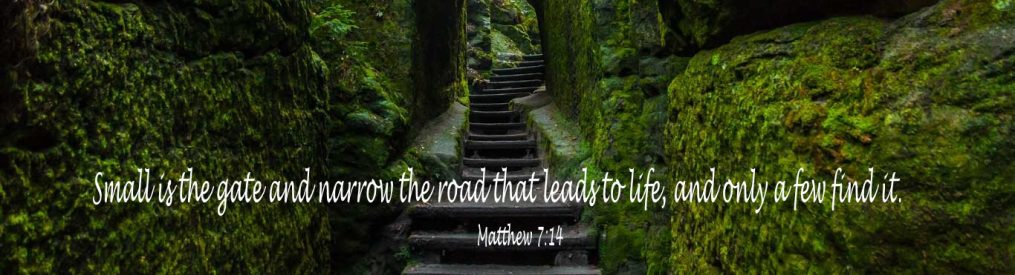
Eve made a choice to eat the fruit and serve it to her husband. Adam made a choice to eat the fruit, even though he, too, knew it was forbidden. We all make choices, and we can choose whether or not to partake, yet if we do, we must know that there will surely be consequences. We can eat of the fruit, or not, but that road, if we choose to go down it, is wide and well-traveled, and where it leads? Well, that’s a different matter all together. And, making our way back? Well, as we have been told, “Small is the gate and narrow the path that leads to life and only a few find it.” (Matthew 7:14)

The narrow road is fraught with difficulties and challenges, because our desire to back up, to have a do-over, our resolve in the matter, will be tested again and again. Speaking truth in the face widespread dishonesty and doing what’s right, when no one else does, is not easy. Accepting our shortcomings, taking responsibility for them and resolving to change is harder still. Yet this story challenges us to confront the difficulties we face in life, to own up to our faults, to look for that “narrow” path. In truth, life is difficult, it’s unfair, no matter which path we take, but the difference is this: The narrow path teaches us so much more about ourselves, about the nature of reality, of God, and how we fit into the cosmic plan; it gives us perspective and teaches us perseverance, and trust, and leads us to life, and to God’s peace.

~SLM


The Poor in Spirit

In the Sermon on the Mount, Christ begins his discourse by saying, “blessed are the poor in spirit, for they will see the kingdom of heaven.” So what does it mean to be poor in spirit? Does it denote those who are below the poverty level or, those who are pitiful, helpless or weak?

Perhaps it could be better understood, if it read humble of spirit – Happy are those who are not full of themselves, who are humble and least in their own eyes. When we are full of ourselves, it’s hard to see beyond the 2-foot sphere of our own personal space, our own point of view.  We are inwardly focused, looking at everything through the narrow scope of me-ness. We can’t see how our actions affect the lives of others, as if the wake we leave behind us in our passing is some mysterious phenomenon that is happening to us rather than being created by us, making us “stiff necked” and “hard-hearted.” When in our conceit, we think we know the answer; there is no room for maturation, no room for toleration, no room for truth. We become egotistic, unresponsive and dismissive, being so convinced of what we “know” that we miss what we need to know. We are in short, arrogant of Spirit.

Yet, if we are humble of Spirit, modest, unpretentious, respectful and obliging, the beauty of life opens up to us. When we realize how little we understand, grasping that our lives affect others in ways we could not begin to imagine, our outlook on life becomes more conscious, more courteous, more reverential. We become receptive of God’s will for us, we see through the eyes of Sprit and become teachable; we see what is important. And this is what is truly important: to keep our eyes fixed on Him who created all things, loving Him with our whole heart, our whole being, seeking His counsel, His way.

It really is an all or nothing proposition. As we are told in Luke 16:13, “No one can serve two masters. Either you will hate the one and love the other, or you will be devoted to the one and despise the other.” We serve either ourselves or God.

~SLM

What Do You Find?

It seems that the whole world in incensed and offended these days. We see all that is insulting and rude, all that is vile and insensitive, and everywhere you turn you hear about how this thing or that is wrong. But the truth is this: It’s not what others say or do that really sets us off, but how we perceive what they say and do, what we think about it.
One thing I know about humans is that we are seekers. We are continually searching, for a good deal, a new idea, a better way, or for something more. We can’t help it, it’s in our nature, it’s how God created us. And something else I know, whether we realize it or not, we ALWAYS find what we looking for. So my question is this: What do you seek, and more importantly, what do you find?
We are told in Matthew 7:7 to “seek and you will find,” but I don’t think we really take the time to understand what is meant by this. We think it means that if we seek God, we will find Him, and this is certainly true, but it’s more complex than this, more intricate. When we are told to “seek and you will find,” we are being tutored in a school of thought, which encompasses an entire universe of possibilities and what we make of them. It is both an instruction and an admonition, and the surest way to know just what it is we are seeking is to examine what we find. It’s an instruction, because it tells us that to be happy, we must seek, and it’s a warning, because it tells us that we must be mindful of what we look for in others and the world around us, how we perceive the events of our life. You see, what we seek is evidenced by what we find, and what we tell others we have found, also tells them what we have sought. If we find discord and strife, hatred and racism, disrespect and inconsideration, we have been seeking it, and likewise, if we find joy and delight, honor and integrity, love and compassion, these are the things we have also sought.

~SLM

Proverbs the Handbook of Life Part V: Words Count

When I was a kid, whenever someone was mean we’d say “sticks and stones will break my bones, but names will never hurt me.”  It’s a glib little saying, meant to help us through a difficult situation by reminding us that what others say of us can only define us when we allow it to, a way to remind ourselves that it is how we are judged by God that counts. But words do have power, they may not break our bones, but they can break our will, our heart, and our spirit. Proverbs 18:21 tells us that every word we speak promotes either life or death, that our words can either encourage or devastate, build up or tear down.

In fact, the Proverbs are filled with warnings about the cavalier use of language. It behooves us, then, to not only watch what we say to others, but also how we say it. There are so many times in life when we just ramble on incessantly, carelessly repeating the latest gossip without ever stopping to think of how our words are impacting those around us. We prattle on, so wrapped up in our own little universe, so convinced that we have the “right” to say anything we want to say, never understanding that while we can say whatever we choose, wisdom dictates that we choose our words carefully, thoughtfully, lovingly.

In Matthew 12:33-37, Christ says this:

33 “Make a tree good and its fruit will be good, or make a tree bad and its fruit will be bad, for a tree is recognized by its fruit. 34 You brood of vipers, how can you who are evil say anything good? For the mouth speaks what the heart is full of. 35 A good man brings good things out of the good stored up in him, and an evil man brings evil things out of the evil stored up in him. 36 But I tell you that everyone will have to give account on the Day of Judgment for every empty word they have spoken. 37 For by your words you will be acquitted, and by your words you will be condemned.”

Words count. They can be the most beautiful sound in the world, or tear our world completely apart, and we can choose every day to speak life.

Heavenly Father,

Fill my life with peace and love. Fill each breath I take with the wonder of your creation. Show me the meaning of faith; let me know it with every fiber of my being. Teach me to trust that no matter how it appears, I am fully taken care of, and that all of my needs are met at every moment. Help me to shine Your light brightly, so others may be witness to Your majesty. Speak to my heart; let Your Word be my guide, so I may speak life in all I do.  Amen.

~SLM

What Now We Harvest

Sometimes it’s the most difficult thing in the world, focusing on the harvest. It’s so easy to get mired down in the drama of everyday life, to get our feelings hurt, if things don’t go exactly as we want them to, and that’s when the temptation to scatter just any old seeds is the strongest.  It’s so much easier to put others down, to puff up our chests with self-righteous indignation for an imagined slight or insult. Matthew 7:8 tells us that whatever we seek we will find, so if we are looking for indignation, we’ll find it, if we’re looking for hate, we’ll find that, too, but, by the same token, of we seek love and compassion, that’s what we find.

It’s so easy to criticize others, to hold them accountable to a standard that we ourselves haven’t the discipline or courage to live by. We are told, “Do not judge, or you, too, will be judged in the same manner that you have judged, and with the same measure that you have used,”(Matthew 7:1-2.) Yet, that doesn’t stop us from looking down on them, from judging them for not leading the exemplary lives that we ourselves are unable to lead. We are, indeed, all hypocrites, aren’t we? We feign outrage when someone else acts in precisely the manner we do. We wail and lament that we find no respect, no honor, no happiness or love, all the while forgetting those seeds we scattered so carelessly, so imprudently – what now we harvest.

~SLM

Unsettled Waters

Sometimes it’s remarkable to me how certain snippets of scripture in moments of synchronicity stand out in our daily lives, asking us to ponder them, to go deeper, and to consider what they can teach us. Lately Matthew 14:25-31 has had such a place in my life, and specifically verses 28-31 where Peter says to Christ, “if it is really you, tell me to come to you on the water, and Jesus says, “come.”
It occurs to me that whenever we move through anxious times, through rough spots in our lives, where everything seems upside down, and we aren’t sure how it will all turn out, this is the time when we have our best opportunity for spiritual growth. It’s the time to be single-minded in our attention, having the strength of faith to keep moving forward, trusting God’s promises to us. This passage is about stepping out in confidence, leaving the safety of the boat to move across the unsettled waters with our eyes fixed on the goal, trusting that we will be held safe in the journey. It’s about letting the storms, no matter what they are, or how they present themselves in our lives, rage about us as they may, without losing our devotion, and coming into the embrace of our future selves, our new selves in Christ.
What I get out of it is this: If we trust in God, we have to trust in His promises, completely, without dropping our focus. It’s when we lose focus, letting the raging wind and churning seas fill our sight, that we fail, that doubt creeps in and we lose faith; our faith in our ability to follow, and more importantly, our faith in the fact that it’s the loving arms of Christ which supports and sustains us, which gives us a “bridge” for troubled waters, and allows us to carry on in miraculous grace.
And so to end, a prayer…
Thank you Lord for your loving care, for your wisdom and guidance. You know just what I need, and you fill my life with peace and love, each breath I take with the wonder of your graciousness. Let me know the meaning of faith with every fiber of my being, know that no matter how it appears, I am fully taken care of, and know that all of my needs are met at every moment. Amen
~SLM


Update:  Songs on the theme that presented themselves over and over…

  1.  www.youtube.com/watch?v=dy9nwe9_xzw